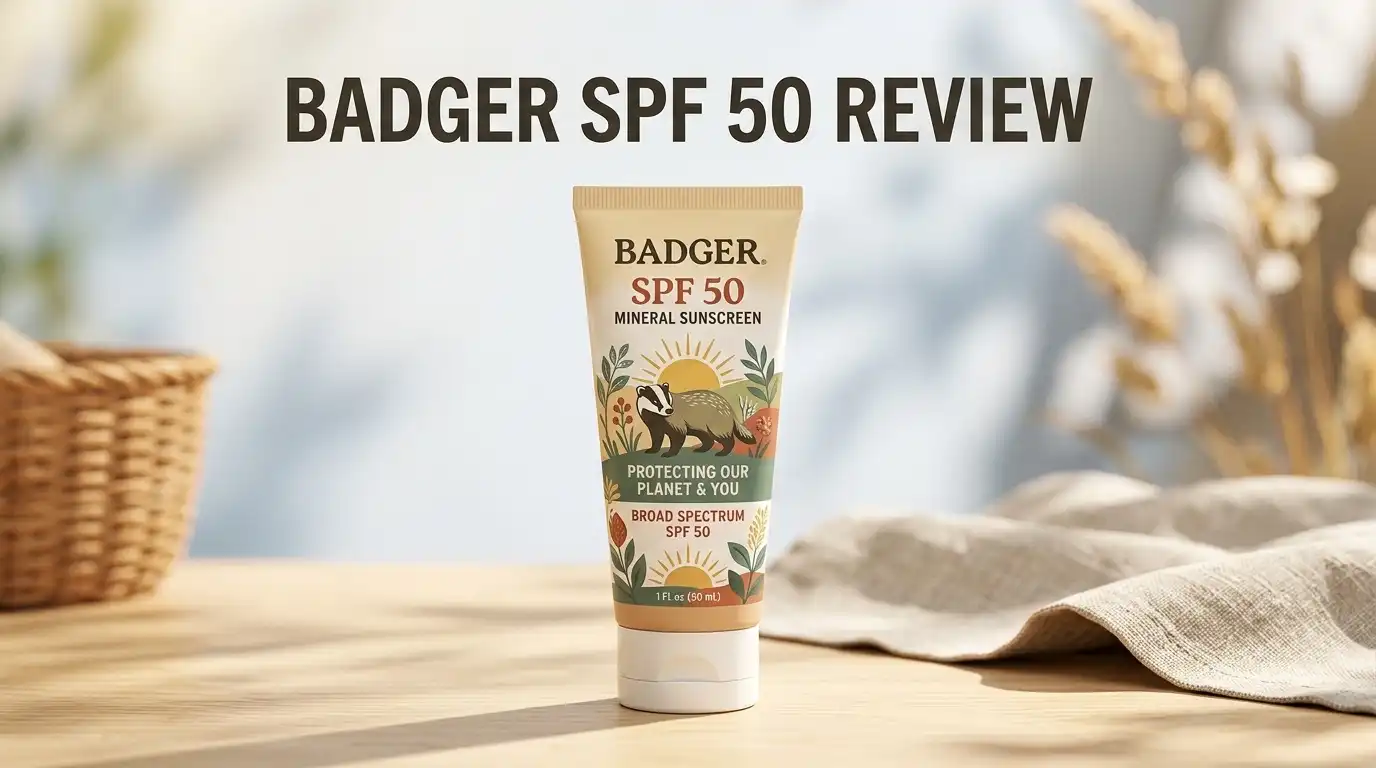
Badger SPF 50 Review 2026: Worth the Hype?
Sunscreen shopping feels confusing. Every bottle promises protection, and every label uses words you cannot pronounce. Badger takes the opposite path with a four ingredient formula that you could almost read out loud to a child.
But short ingredient lists do not always mean good sunscreen. A thick zinc paste protects your skin only if you actually wear it. That is the real test.
I used Badger SPF 50 through beach days, trail runs, and ordinary desk mornings. This review covers the texture, the white cast, the price, and the things Badger genuinely does poorly. No sugarcoating.
In a Nutshell:
- Badger SPF 50 works. It uses 25 percent uncoated non nano zinc oxide, which blocks UVA and UVB rays through physical reflection and absorption. Protection is not the weak point here.
- The texture demands patience. This is a thick, waxy cream that needs warming between your palms before it spreads. Rushing the application leaves streaks and thin spots.
- A white cast exists. Medium and deep skin tones will see it clearly. Badger does not hide this, and neither will I. The Clear Zinc versions reduce it, but the classic Adventure cream leaves a visible tone.
- Water resistance holds up. The Adventure formula stays put for 80 minutes of swimming or sweating. It clings better than most mineral competitors I have tested.
- Ingredients stay simple. Zinc oxide, organic sunflower oil, organic beeswax, and sunflower vitamin E. That is the entire Adventure formula, and it is 98 percent organic.
- Price runs high per ounce. You pay a premium for organic sourcing and small batch manufacturing in New Hampshire. Budget shoppers will feel the sting.
- Sensitive skin loves it. No fragrance, no chemical filters, no oxybenzone. It is one of the safest picks for reactive skin and small children.
What Is Badger SPF 50 Sunscreen?

- MAXIMUM PERFORMANCE MINERAL SUNSCREEN: Broad Spectrum SPF 50 protection using non-nano uncoated Zinc Oxide to shield against UVA & UVB rays, clinically tested safe for sensitive skin, suitable sunblock for face, body, and heavy outdoor activity
- CLEAN & 98% ORGANIC INGREDIENTS: Formulated with just 4 simple ingredients: mineral zinc oxide, organic sunflower oil, organic beeswax, & sunflower vitamin E, making it NSF Certified Organic, non-GMO, gluten-free, and chemical-free
Last update on 2026-07-23 / Affiliate links / Images from Amazon Product Advertising API Some of the links on this website are affiliate links, which means that at no additional cost to you, I earn a commission if you click through and make a purchase. I only recommend products and services that I believe will add value to my readers. Thank you for your support!
Badger is a family owned company based in Gilsum, New Hampshire. They started with balms in 1995 and expanded into mineral sunscreen years later.
The SPF 50 line includes two main players. The Adventure Mineral Sunscreen Cream targets hiking, surfing, and long outdoor days. The Daily Mineral Sunscreen offers a lighter feel for everyday wear.
Both use zinc oxide as the only active ingredient. No avobenzone, no octinoxate, no homosalate. Your skin gets a mineral shield instead of a chemical filter.
The Adventure version contains just four ingredients. Zinc oxide sits at 25 percent, which is near the top of what any brand uses.
That high percentage explains both the strong protection and the thick feel. You cannot pack that much mineral into a cream and expect it to vanish like water.
Badger holds Protect Land and Sea certification, meaning the formula avoids ingredients linked to coral reef damage. Hawaii, Key West, and several other regions restrict certain chemical filters, and Badger clears those rules easily.
The company runs on solar power and packages products in tubes made from 50 percent recycled plastic. Some buyers care about that. Others just want sun protection.
Either way, the product exists in a small group of sunscreens where the ingredient list actually fits on one line.
Unboxing and First Impressions
The 2.9 fluid ounce tube arrives in a slim cardboard sleeve. No plastic wrap, no oversized box, no marketing insert.
The tube feels sturdy. The cap clicks shut with a firm snap, which matters when the thing rattles around in a beach bag.
My first squeeze surprised me. The cream came out slowly, almost like cold cake frosting, and held its shape on my palm.
It smells faintly of sunflower oil and beeswax. Not perfumed, not chemical, just quietly natural. Some people describe it as a mild honey scent.
The 2.4 ounce tin version behaves differently. Tin packaging means you dig product out with your fingers, which gets messy with sandy hands.
I prefer the tube for travel and the tin for home use. The tin also survives being dropped, while a tube can split at the seam under pressure.
Temperature changes the experience completely. On a cool morning, the cream feels stiff and resists spreading.
Leaving the tube in a warm car softens it beautifully. Warming a small amount between your fingertips for ten seconds solves most application complaints.
That single trick changed my opinion of the product. Straight from a cold bag, it feels like a chore. Warmed properly, it glides.
What Is Inside the Formula
The Adventure SPF 50 contains uncoated non nano zinc oxide at 25 percent. Non nano means the particles measure larger than 100 nanometers, so they sit on the skin surface rather than passing through it.
Organic sunflower seed oil forms the base. It carries the zinc, adds slip, and delivers linoleic acid that supports the skin barrier.
Organic beeswax provides the water resistance. It creates a flexible film that resists rinsing off, which is why this formula survives swimming better than lighter lotions.
Sunflower vitamin E rounds out the list as an antioxidant. It protects the oils from going rancid and adds a small free radical defense.
Notice what is missing. No water, no preservatives, no emulsifiers, no fragrance, no dimethicone.
A waterless formula does not need preservatives because bacteria cannot grow without moisture. That is a genuinely clever piece of formulation.
The Daily SPF 50 swaps in coconut oil, sunflower wax, castor wax, and coconut fruit extract. It feels lighter and reaches 85 percent organic content instead of 98 percent.
Zinc oxide protects across the full UVA and UVB range on its own. Chemical sunscreens usually need three or four filters combined to match that coverage.
The tradeoff is cosmetic. Chemistry that simple cannot also be invisible. You trade elegance for transparency.
How Badger SPF 50 Performs on Skin

- MAXIMUM PERFORMANCE MINERAL SUNSCREEN: Broad Spectrum SPF 50 protection using non-nano uncoated Zinc Oxide to shield against UVA & UVB rays, clinically tested safe for sensitive skin, suitable sunblock for face, body, and heavy outdoor activity
- CLEAN & 98% ORGANIC INGREDIENTS: Formulated with just 4 simple ingredients: mineral zinc oxide, organic sunflower oil, organic beeswax, & sunflower vitamin E, making it NSF Certified Organic, non-GMO, gluten-free, and chemical-free
Last update on 2026-08-17 / Affiliate links / Images from Amazon Product Advertising API Some of the links on this website are affiliate links, which means that at no additional cost to you, I earn a commission if you click through and make a purchase. I only recommend products and services that I believe will add value to my readers. Thank you for your support!
Application takes effort. I squeeze roughly a nickel sized amount for my face and rub it between my fingers first.
Spread it in small sections rather than trying to cover an arm in one pass. Sections give you even coverage without streaks.
The finish sits somewhere between matte and satin. It is not greasy the way many oil based sunscreens feel, but it does leave a slight tackiness for the first ten minutes.
After twenty minutes, the tackiness fades. Sand still sticks to it at the beach, which annoyed me more than anything else.
Protection performance impressed me. I spent six hours on open water in July and reapplied twice. No burn, not even pink patches on my shoulders.
My nose and ears, which normally burn first, stayed clear. That says something about how well the zinc layer holds.
Sweat resistance ranks near the top of mineral sunscreens I have used. During a hot trail run, it did not sting my eyes or drip down my forehead.
Removal requires actual cleansing. Water alone will not lift a beeswax and zinc film off your face.
An oil cleanser followed by a gentle face wash removes it fully. Skipping that step leaves residue that can clog pores overnight.
Performance is the strong half of this product. The weak half comes next.
White Cast and Skin Tone Reality Check
Let me be direct. The Adventure SPF 50 leaves a white cast, and no application technique erases it completely.
On fair skin, the cast reads as a pale, slightly ghostly tone that mostly settles within fifteen minutes. Most fair skinned users find it acceptable.
On medium skin, the cast shows in photos and in bright light. You will notice a grayish tint at your hairline and jaw.
On deep skin, the cast becomes obvious and stays obvious. This is the single biggest reason to skip the Adventure formula.
Badger does offer Clear Zinc versions that use a different zinc treatment. Those reduce the cast significantly but do not eliminate it.
Uncoated zinc oxide sits on the surface and reflects light. That is exactly how it protects you, and it is also why it shows.
Some users mix a drop of tinted moisturizer or foundation into the cream. That works, though it slightly thins the layer and may reduce coverage if you overdo it.
Body application matters less. Nobody photographs their calves in good lighting.
Face application is where the cast becomes a daily decision. If you wear makeup or attend meetings, test it before committing to a full tube.
I found the cast tolerable for outdoor days and irritating for office mornings. Your tolerance may differ, and that is a fair reason to choose a different product.
Water Resistance and Sweat Testing
The Adventure formula carries an 80 minute water resistance rating. That is the maximum any sunscreen can legally claim in the United States.
I tested it in a pool, in ocean water, and during a humid August hike. It held in all three settings.
After swimming, my skin still felt slightly coated when I ran a hand across my forearm. That coated feeling is a useful signal that the layer survived.
Towel drying is the real enemy. Rubbing with a rough towel strips more sunscreen than swimming does.
Pat yourself dry instead of scrubbing. That small habit extends your protection considerably.
The Daily SPF 50 only rates 40 minutes of water resistance. It is built for commuting and errands, not for surf sessions.
Sweat performance stood out during running. Many mineral sunscreens turn into white rivers on a sweaty forehead, and this one did not.
The beeswax film seems to lock the zinc in place. I never had to rinse burning residue out of my eyes.
Reapplication every two hours remains necessary regardless. No sunscreen protects indefinitely, and marketing claims never change that rule.
I carried the tin for reapplication because it fits in a pocket. Scooping product with dry fingers works better than fighting a tube with wet hands.
Badger SPF 50 for Faces
Facial use splits opinion sharply. The Adventure cream is heavy, and oily skin types may struggle.
I have combination skin, and I noticed shine within two hours. Blotting paper fixed it, but the fix was necessary.
Dry skin types get a better experience. The sunflower oil base doubles as a moisturizer, so you can skip your regular cream underneath.
Acne prone users should proceed carefully. Zinc oxide itself is calming and rarely causes breakouts.
The heavy oil and wax base is the risk factor. Coconut oil in the Daily formula ranks higher on comedogenic scales than sunflower oil.
If you break out easily, the Adventure version with sunflower oil is the safer of the two. Patch test along your jaw for three days first.
The formula sits poorly under most makeup. Foundation tends to grab and streak over the waxy film.
Waiting a full ten minutes before applying makeup helps. Using a powder foundation instead of liquid helps more.
For a sensitive face with rosacea or eczema, this sunscreen performs beautifully. No fragrance and no chemical filters means very little to react against.
Badger SPF 50 is a great outdoor face sunscreen and a mediocre everyday one. That distinction matters when you decide what to buy.
Badger SPF 50 for Kids and Babies
Parents form a large part of Badger’s customer base, and the reasoning is sound. Children absorb chemical filters more readily than adults because of their higher surface area relative to body weight.
Mineral only formulas avoid that question entirely. Zinc oxide stays on the surface and washes off later.
Badger sunscreens carry hypoallergenic testing and skip fragrance completely. Those two facts remove most common irritation triggers for young skin.
The thick texture actually helps with kids. You can see exactly where you applied it, so missed patches are obvious.
That visibility solves the classic problem of a child arriving home with a burned stripe down one shoulder. White streaks are easy to spot and easy to fix.
Application on a squirming toddler still takes time. Warming the product first makes the process much faster.
Badger also sells a dedicated Baby formula at SPF 40. For infants under six months, shade and clothing remain the recommended approach rather than any sunscreen.
Older kids handle the SPF 50 Adventure version fine. Just plan for a few minutes of complaining about the cast.
The Kids formula includes a light tangerine and vanilla scent, which some children prefer. Sensitive skinned kids should stick with unscented.
For families, this ranks among the safest sunscreens available. The tradeoffs are cosmetic, not safety related.
What Badger SPF 50 Does Not Do Well
Honest reviews name the failures, so here they are.
The white cast is real and persistent, especially on deeper skin tones. Badger has not solved this in the Adventure line.
The texture is genuinely thick. Cold weather makes it stiff enough to feel like spreading candle wax.
Price per ounce runs roughly double what drugstore mineral sunscreens cost. A 2.9 ounce tube does not last long if you cover your whole body.
You will use more product than you expect. Proper coverage for an adult body takes about one ounce, so a tube covers under three full applications.
The tube can be difficult to squeeze when cold. Some users report the seam splitting under hard pressure.
Under makeup, it performs poorly. Foundation pills and streaks over the waxy surface.
Removal requires an oil cleanser. Rinsing with water leaves a film that some people find pore clogging.
Sand sticks to the surface at the beach. It is not the product’s fault exactly, but it happens more here than with lighter lotions.
The Daily version’s 40 minute water resistance disappoints anyone who expected all day performance. Read the label before you buy.
None of these are safety problems. They are all convenience problems, and convenience determines whether you keep wearing sunscreen.
Pros and Cons of Badger SPF 50
Pros
- Only four ingredients in the Adventure formula, all recognizable and 98 percent organic certified.
- Zinc oxide at 25 percent delivers strong broad spectrum coverage against both UVA and UVB rays without chemical filters.
- Water resistant for 80 minutes, which is the highest rating available in the United States.
- No fragrance, no oxybenzone, no octinoxate, making it a reliable choice for sensitive, reactive, and children’s skin.
- Protect Land and Sea certified, so it meets reef safe rules in Hawaii, Key West, and Palau.
- Waterless formula needs no preservatives and offers genuine moisturizing benefits from sunflower oil and vitamin E.
- Sustainable operations including solar powered manufacturing and packaging made from 50 percent recycled plastic.
- Visible application helps parents confirm full coverage on wriggling children.
Cons
- Noticeable white cast that becomes a serious problem on medium and deep skin tones.
- Thick, waxy texture that requires warming between your palms before it spreads evenly.
- Higher price per ounce than most drugstore mineral alternatives.
- Poor performance under makeup, with foundation streaking and pilling over the surface.
- Requires oil based cleansing to remove completely at the end of the day.
- Small tube size relative to how much product a full body application actually needs.
- Stiffens in cold weather, making early morning or winter application slow.
- Sand clings to the surface during beach use.
Price and Value
A 2.9 ounce tube typically sells in the mid to high teens. The 2.4 ounce tin lands in a similar range.
Compare that to Thinksport at roughly half the cost per ounce, and Badger looks expensive. That comparison is fair.
What you buy with the extra money is transparency. Four organic ingredients sourced through direct farm partnerships and manufactured in a solar powered New Hampshire facility.
Some buyers value that. Others reasonably do not.
Value also depends on how you use it. As a face and shoulders sunscreen for outdoor days, one tube lasts weeks.
As a full body beach sunscreen for a family of four, a tube disappears in two days. That math turns the price from reasonable into painful.
I recommend buying the tin or tube for face and targeted areas. Use a cheaper mineral lotion for legs and torso where cosmetic finish matters less.
That combination gives you Badger quality where you notice it and budget savings where you do not.
Multipacks reduce the cost per unit somewhat. Watch for seasonal discounts in early spring before summer demand rises.
Badger is a premium product at a premium price. Whether that equals good value depends entirely on your priorities and your budget.
Who Should Buy Badger SPF 50 and Who Should Skip It
Buy it if you have sensitive skin that reacts to chemical filters. The short ingredient list gives your skin very little to fight.
Buy it if you swim or sweat heavily outdoors. The beeswax film outperforms most mineral competitors on water resistance.
Buy it if you want a genuinely reef friendly sunscreen for travel to Hawaii or the Caribbean. The certification is real.
Buy it for children who need reliable, fragrance free protection. Visible coverage helps parents apply it properly.
Skip it if you have deep skin and hate white cast. The Adventure formula will frustrate you daily.
Skip it if you need a sunscreen that works under makeup. This one does not, and no technique fully fixes that.
Skip it if you have very oily skin. The oil and wax base adds shine that most oily types dislike.
Skip it if budget drives your decision. Cheaper mineral sunscreens protect you nearly as well.
Try the Daily SPF 50 or a Clear Zinc version if you like the brand but hate the texture. Those formulas feel lighter and cast less.
Badger SPF 50 is a good sunscreen with a specific personality. It rewards people who prioritize ingredient quality and outdoor durability over cosmetic elegance.
Final Verdict
Yes, Badger SPF 50 is a good sunscreen. It protects reliably, resists water well, and uses one of the cleanest formulas on the market.
It is not a good sunscreen for everyone. The white cast and heavy texture rule it out for a large group of users, and pretending otherwise would be dishonest.
Think of it as outdoor gear rather than skincare. You would not wear hiking boots to a dinner party, and you would not wear this under foundation.
For beach days, trail runs, boat trips, and children’s play, it earns a strong recommendation. For daily office wear on medium or deep skin, look elsewhere.
I keep a tin in my hiking pack and a lighter sunscreen on my bathroom shelf. That split works well.
Frequently Asked Questions
Does Badger SPF 50 leave a white cast?
Yes. The Adventure formula leaves a visible white cast because it uses 25 percent uncoated zinc oxide. Fair skin tones see minimal cast after fifteen minutes. Medium and deep tones see it clearly. The Clear Zinc versions reduce the cast noticeably but do not remove it entirely.
Is Badger SPF 50 reef safe?
Badger holds Protect Land and Sea certification and uses only non nano zinc oxide. It contains no oxybenzone or octinoxate, the two filters most often linked to coral damage. It meets the sunscreen rules in Hawaii, Key West, and Palau.
How long does Badger SPF 50 last in water?
The Adventure Mineral Sunscreen Cream rates 80 minutes of water resistance, the maximum allowed in the United States. The Daily Mineral Sunscreen rates 40 minutes. Reapply after swimming, after towel drying, and at least every two hours in direct sun.
Can I use Badger SPF 50 on my face?
Yes, though results vary by skin type. Dry and sensitive skin benefits from the sunflower oil base. Oily skin may find it too shiny. Acne prone users should patch test along the jaw for three days before full application.
How do I remove Badger SPF 50?
Use an oil based cleanser first, then a gentle face wash. Water alone will not break down the beeswax and zinc film. Skipping proper cleansing can leave residue that clogs pores.
Is Badger SPF 50 safe for babies?
Badger sunscreens are widely considered safe for children and use only mineral filters. For infants under six months, dermatologists recommend shade and protective clothing instead of any sunscreen. Badger sells a dedicated Baby formula at SPF 40 for older infants.
Why is Badger SPF 50 so thick?
The high zinc concentration combined with beeswax and no water creates a dense cream. Warm a small amount between your fingertips for about ten seconds before applying. That step alone solves most spreading complaints.

Hi, I’m Rosalie Celeste, your trusted product reviewer and the voice behind Purely Rated. I’m passionate about helping everyday shoppers make informed decisions by sharing my honest, first-person experiences with Amazon products across fashion, beauty, supplements, and lifestyle categories. With a keen eye for quality and value, I test and review products that I genuinely use in my daily life, so you know you’re getting authentic insights.