Antipodes Eye Cream Review 2026: Worth It?
Dry, crepey under-eyes that flake by 4pm are a specific kind of annoying. Concealer clings to the texture. Every fine line looks deeper than it is.
That crepiness is a lipid problem, not a wrinkle problem. Thin orbital skin runs out of oil faster than the rest of your face.
The Antipodes Kiwi Seed Oil Eye Cream was built for exactly that. It is a New Zealand botanical formula that has held shelf space since 2006, which is unusual staying power in this category.
In A Nutshell
- The base does the work, not the kiwi. Avocado oil sits second on the ingredient list. Kiwi seed oil sits fourteenth, below the preservatives. It is a signature accent rather than the engine.
- Genuinely fragrance-free. No essential oils, no added perfume. That matters more around the eyes than anywhere else, and most natural eye creams fail this test.
- Best for dry to normal skin. Borage seed oil brings gamma-linolenic acid and bisabolol calms. Together they soften winter crepiness within about a week.
- The 82% collagen figure is in-vitro. Those numbers came from cultured skin cells in a lab, not from human trials. Treat it as directional, not proven.
- It will not touch pigment. No niacinamide, no vitamin C derivative, no peptides. Hereditary or post-inflammatory dark circles stay exactly where they are.
- Jar packaging is the main flaw. Fingers in a lipid-rich cream shortens its life. A tiny spatula fixes it, but at this price airless packaging should have been standard.
Verdict: a competent maintenance cream for dry, reactive eyes. Not a transformation product.
Antipodes Kiwi Seed Oil Eye Cream

Last update on 2026-08-03 / Affiliate links / Images from Amazon Product Advertising API Some of the links on this website are affiliate links, which means that at no additional cost to you, I earn a commission if you click through and make a purchase. I only recommend products and services that I believe will add value to my readers. Thank you for your support!
The full name is a mouthful, so most people shorten it to the kiwi seed eye cream. It runs 30ml for roughly $50 USD.
Antipodes was founded in Wellington in 2004 by Elizabeth Barbalich, a biology graduate. The brand commissions its own lab testing, which was rare for indie naturals at the time.
This particular formula launched in 2006 and has survived several preservative reformulations. The fatty acid ratio stayed intact through all of them.
It is vegan, cruelty-free, and safe during pregnancy. No retinoids, no salicylic acid, no restricted essential oils.
The positioning is anti-aging, but read that carefully. Antipodes claims softer fine lines and better hydration, not erased wrinkles.
What you are buying is a botanical emollient with a real antioxidant active in it. That combination is more thoughtful than most clean-beauty eye creams manage.
Whether it earns $50 depends entirely on your under-eye concern. I will get to that.
My First Impressions Out Of The Box
The outer carton is FSC-certified card printed with soy inks. No plastic film, no insert, no filler.
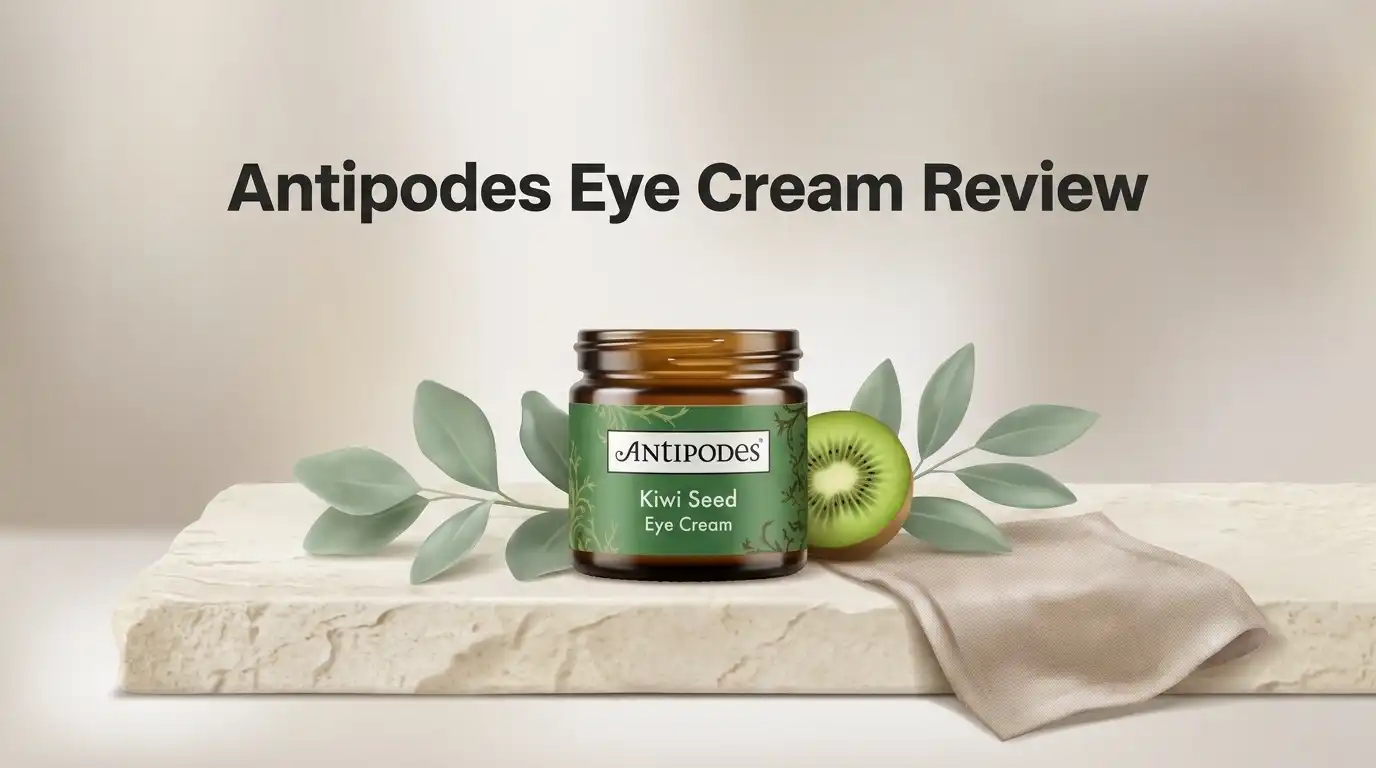
Inside sits a heavy frosted-glass jar with a screw lid. It feels substantially more expensive than the price suggests.
The lid unscrews with a clean quarter turn. No inner disc, no foil seal beyond the shrink band, which surprised me slightly.
The cream sits flush at the top of the jar. Colour is off-white with a faint green-grey cast from the avocado oil.
There is no spatula included. For a jar of oil-rich cream at this price, that omission is a genuine miss.
The jar is short and wide, which makes it stable on a shelf but awkward in a toiletry bag. Glass in luggage is always a gamble.
Batch code and expiry are printed on the base. Period-after-opening is six months, which is shorter than most and worth noting.
Overall the unboxing feels considered rather than luxurious. Nothing theatrical, nothing wasteful.
What The Ingredient List Actually Tells You
The list runs sixteen ingredients. That is short, and short lists usually mean fewer variables to react to.
Aqua comes first, then avocado oil, then glycerine. Those three are the structure of the product.
Avocado oil is roughly 70% oleic acid with sterolins and vitamins A, D and E. It mimics sebum and slides into the gaps between skin cells.
Borage seed oil is the standout. It is the richest plant source of gamma-linolenic acid, an omega-6 the skin converts into anti-inflammatory compounds.
Kiwi seed oil contributes alpha-linolenic acid, an omega-3 fraction that is harder to source topically. Its position on the list means the dose is modest.
Vinanza Grape seed extract is the antioxidant. It is standardised for oligomeric proanthocyanidins, which outperform vitamin C as free-radical quenchers and survive in oil bases where ascorbic acid would oxidise.
Bisabolol from chamomile handles soothing. Tocopherol adds a second antioxidant layer.
Preservation runs on dehydroacetic acid and benzyl alcohol. Both are gentle at these levels.
The two flags: carrot seed oil can sting stripped skin, and benzyl alcohol irritates a small minority.
Top 3 Alternative For Antipodes Kiwi Seed Oil Eye Cream
If the jar format or the price stops you, these three cover the same ground differently.

- WHAT IT IS: A Feather-Light, Omega-Fueled Cream For Sensitive Eyes Which Hydrates Without Heaviness. Fragrance-Free + Suitable For All Skin Types.
- WHAT IT DOES: Rich In Essential Fatty Acids, Echium Helps To Improve The Appearance Of Fine Lines + Keep The Delicate Eye Area Plumped, While Argan + Rosehip Oils Deeply Nourish.
Last update on 2026-08-03 / Affiliate links / Images from Amazon Product Advertising API Some of the links on this website are affiliate links, which means that at no additional cost to you, I earn a commission if you click through and make a purchase. I only recommend products and services that I believe will add value to my readers. Thank you for your support!
Pai Skincare Echium + Hyaluronic Acid Feather Canyon Eye Cream

- Intensive Hydration: Quickly hydrates the delicate under eye area, smoothing the appearance of fine lines and reducing puffiness
- Fast Absorbing: A gel-cream formulation that absorbs rapidly, leaving no residue, perfect for daily use
Last update on 2026-08-03 / Affiliate links / Images from Amazon Product Advertising API Some of the links on this website are affiliate links, which means that at no additional cost to you, I earn a commission if you click through and make a purchase. I only recommend products and services that I believe will add value to my readers. Thank you for your support!
Trilogy Eye Contour Cream

- Rejuvenates and hydrates.
- Reduces puffiness and dark circles.
Last update on 2026-08-03 / Affiliate links / Images from Amazon Product Advertising API Some of the links on this website are affiliate links, which means that at no additional cost to you, I earn a commission if you click through and make a purchase. I only recommend products and services that I believe will add value to my readers. Thank you for your support!
Weleda Wild Rose Smoothing Eye Cream
Texture, Scent And How It Absorbs
This is a proper cream, not a gel and not a balm. It holds its shape on a fingertip without slumping.
Density sits medium-weight with a slightly buttery drag. It does not slip like a silicone-based formula.
Warmed between two fingers it thins noticeably. That step matters, because applied cold it drags on thin skin.
Absorption takes about two minutes on my normal to dry skin. It settles into a satin film rather than disappearing entirely.
That film is the point. It is an occlusive layer holding water in overnight.
Scent is faintly nutty and slightly green. That is the cold-pressed oils themselves, and it fades inside sixty seconds.
Nobody has ever commented on it. There is no added fragrance at all, which is the whole reason I kept using it.
Under makeup it needs patience. Give it four or five minutes before concealer, or you will get pilling.
On very oily lids it lingers longer and can feel greasy for a while. That is a real limitation, not a nitpick.
The Collagen Claim, Read Honestly
Antipodes prints a figure on the packaging: an 82% increase in Type I collagen synthesis in human skin cells.
That number is real and the testing happened. The context is what marketing leaves out.
The test was in-vitro, meaning cultured fibroblasts in a dish. Cells in a dish sit in direct contact with the formula.
Your orbital skin has a stratum corneum on top of it. Very little of a cream crosses that barrier at meaningful concentration.
So the gap between 82% in a dish and any measurable change on your face is wide. Nobody has closed it with a clinical trial.
The claim has also not been replicated by independent labs. That does not make it false, only unverified.
Here is the honest version: the fine-line softening people report is real, but it comes from hydration and lipid replenishment. Plumped skin reflects light differently, and shallow lines look shallower.
That is a legitimate cosmetic result. It is simply not structural collagen remodelling, and no botanical oil delivers that.
Judge the cream on barrier support. It performs well there.
What Changed After Eight Weeks
Week one delivered the obvious win. My under-eyes stopped feeling tight by mid-afternoon.
Flaking stopped within four days. That alone made concealer sit better, which read as brightness.
By week three the crepey texture on my left eye had softened noticeably. Not gone, softened.
Fine lines under both eyes looked shallower in daylight. In harsh bathroom lighting they were still very much there.
My dark circles did not change. Mine are partly vascular and partly shadow, and the formula has no mechanism for either.
Puffiness stayed the same. There is no caffeine here and nothing draining.
Around week six I hit a plateau. Everything held steady rather than continuing to improve.
Zero irritation across eight weeks, including through a cold snap when my skin was reactive. That is the strongest thing I can say about it.
Milia did not appear, though I am not prone to them. Anyone who is should apply on the orbital bone only.
Net result: a maintenance product that keeps the area comfortable and smooth. Modest, consistent, unexciting.
Who This Eye Cream Suits Best
The clearest fit is dry to normal under-eye skin in the thirties through fifties. That is where the fatty acid blend earns its keep.
Fragrance-sensitive people should look here first. Most natural eye creams perfume with essential oils that read clean and trigger contact dermatitis.
Rosacea-prone and reactive skin does well with it. The short list and the bisabolol keep the irritant load low.
Retinoid users get real value from it. Apply your tretinoin first, wait two minutes, then pat this over as a buffering seal.
Anyone pregnant or nursing can use it without checking anything. No retinoids, no hydroquinone, no restricted oils.
Winter skin benefits most. This is a cold-weather formula, and I would swap to something lighter in July.
People who care about provenance will appreciate the twenty-year track record. Formulation problems surface long before year twenty.
And if you dislike plastic, the glass jar is a genuine plus rather than a compromise.
Who Should Skip This One
Skip it if your main concern is pigmented dark circles. There is nothing here that touches melanin, and pretending otherwise wastes your money.
Skip it for puffiness and bags. No caffeine, no drainage support, no cooling applicator.
Very oily lids will find it slow and heavy. Sample it before committing $50.
Anyone with active milia should be cautious. The avocado base is comedogenic around 2 on a 0 to 5 scale.
If you want measurable structural change, this is the wrong category entirely. Peptides and prescription retinoids do that work.
Jar-format skeptics have a fair point. Fingertip contact into a lipid-rich cream shortens stability, and the six-month PAO reflects that.
Travellers should think twice. Glass, wide, heavy.
Budget-focused shoppers can get comparable barrier support for a third of the price. You lose the standardised grape extract and the brand history.
And if you already own a good ceramide eye cream that works, this will not outperform it. Honest is honest.
Pros And Cons
Pros
- Genuinely fragrance-free, with no essential oils hiding behind a natural label.
- Avocado, borage and kiwi seed oils cover oleic, linoleic, gamma-linolenic and alpha-linolenic acids, so barrier support comes from four directions.
- Vinanza Grape seed extract is a standardised antioxidant, not decorative botanical marketing.
- Short sixteen-ingredient list keeps the irritant load low for reactive skin.
- Pregnancy-safe, vegan and cruelty-free with credible certification behind it.
- Recyclable glass and FSC card rather than plastic and cellophane.
- Twenty years on shelf, which is meaningful reassurance.
- One jar lasts four to six months at twice-daily use.
Cons
- Jar packaging invites contamination and shortens the life of an oil-rich formula.
- No spatula supplied at a $50 price point.
- Zero action on pigmented dark circles or puffiness.
- Absorbs slowly on oily lids and can pill under heavy concealer.
- The 82% collagen figure is in-vitro only and unreplicated independently.
- Carrot seed oil and benzyl alcohol can sting compromised skin.
- Migrates into the eye and blurs vision if applied too close to the lash line.
- Six-month period-after-opening is short.
Packaging, Value And Shelf Life
The frosted-glass jar is part of Antipodes’ founding stance against plastic. The brand credits that choice with avoiding millions of plastic containers.
Environmentally that argument holds. Practically, an open jar and an oil-heavy formula are a poor pairing.
Every finger dip introduces bacteria and air. A cheap ceramic or steel spatula solves it in one step.
On value: 30ml at $50 works out near $1.67 per millilitre. That sits mid-range for natural eye creams.
It undercuts La Mer and Tata Harper comfortably. It sits close to Pai and REN. It costs several times more than drugstore ceramide options.
A rice-grain per eye twice daily stretches the jar four to six months. Roughly thirty cents a day.
No larger size exists, so there is no way to improve the per-unit cost.
Store it away from the shower and out of sunlight. Heat and light degrade cold-pressed oils faster than anything else.
If the cream ever smells sharp or crayon-like, the oils have turned. Replace it.
How I Apply It In My Routine
Order matters more than amount. This goes on after watery serums and before any face moisturiser or SPF.
I scoop a rice-grain amount per eye with a spatula, then warm it between two fingertips.
Then I pat, never rub. Rubbing thin skin stretches it and achieves nothing useful.
Placement is the orbital bone, the ridge you can feel underneath the eye. Never the lash line and never the tear duct.
Product creeping into the eye is the most common complaint about this cream. Correct placement eliminates it entirely.
I sweep whatever remains across the brow bone. That area gets ignored and thins with age too.
In the morning I wait four minutes, then apply facial SPF over the top. This contains no UV filters, so sunscreen is non-negotiable.
At night it goes on after a peptide serum and before a night cream. It layers cleanly under both.
If I have used tretinoin, I wait two full minutes first. The oils then act as a cushion rather than a diluent.
Twice daily, consistently, for six to eight weeks before judging results.
Expert FAQs
Does the Antipodes eye cream work on dark circles?
Partially, and only one type. Shadow-style circles caused by thin, dry, crepey skin look better because the surface reflects light more evenly. Pigmented circles will not lighten, since the formula contains no tyrosinase inhibitors like niacinamide, kojic acid or vitamin C derivatives.
Can I use it with retinol or tretinoin?
Yes, and it pairs well. Apply your retinoid first and keep it off the lash line, wait two minutes, then pat the cream over as a buffering seal. The borage and avocado oils reduce the flaking that retinoids cause around the eyes.
Is it safe during pregnancy?
Yes. There are no retinoids, no salicylic acid and no hydroquinone. The carrot ingredient here is seed oil, not carrot seed essential oil, which is the restricted version. Check with your own doctor if you have specific concerns.
Will it clog pores or cause milia?
For most people, no. Avocado oil rates around 2 on the comedogenic scale. If you are milia-prone or have oily lids, apply to the orbital bone below the eye and leave the lid itself alone.
How does it compare to the Gold Luminous version?
The Gold variant adds 23-karat gold flakes and mica for a light-reflecting finish, plus Kakadu plum for brightening. It has a richer texture and a higher price. This original is the simpler, more focused formula, and better if you want fatty acids without shimmer.
How long does one jar last?
Four to six months with twice-daily use at a rice-grain per eye. Use a spatula rather than fingers to protect the lipid base, since the period-after-opening is only six months.
Is it worth $50?
If your under-eyes are dry, reactive or fragrance-sensitive, yes. The formulation logic is sound and the fragrance-free promise is honest. If your concern is pigment, puffiness or structural wrinkles, spend the money elsewhere.

Hi, I’m Rosalie Celeste, your trusted product reviewer and the voice behind Purely Rated. I’m passionate about helping everyday shoppers make informed decisions by sharing my honest, first-person experiences with Amazon products across fashion, beauty, supplements, and lifestyle categories. With a keen eye for quality and value, I test and review products that I genuinely use in my daily life, so you know you’re getting authentic insights.